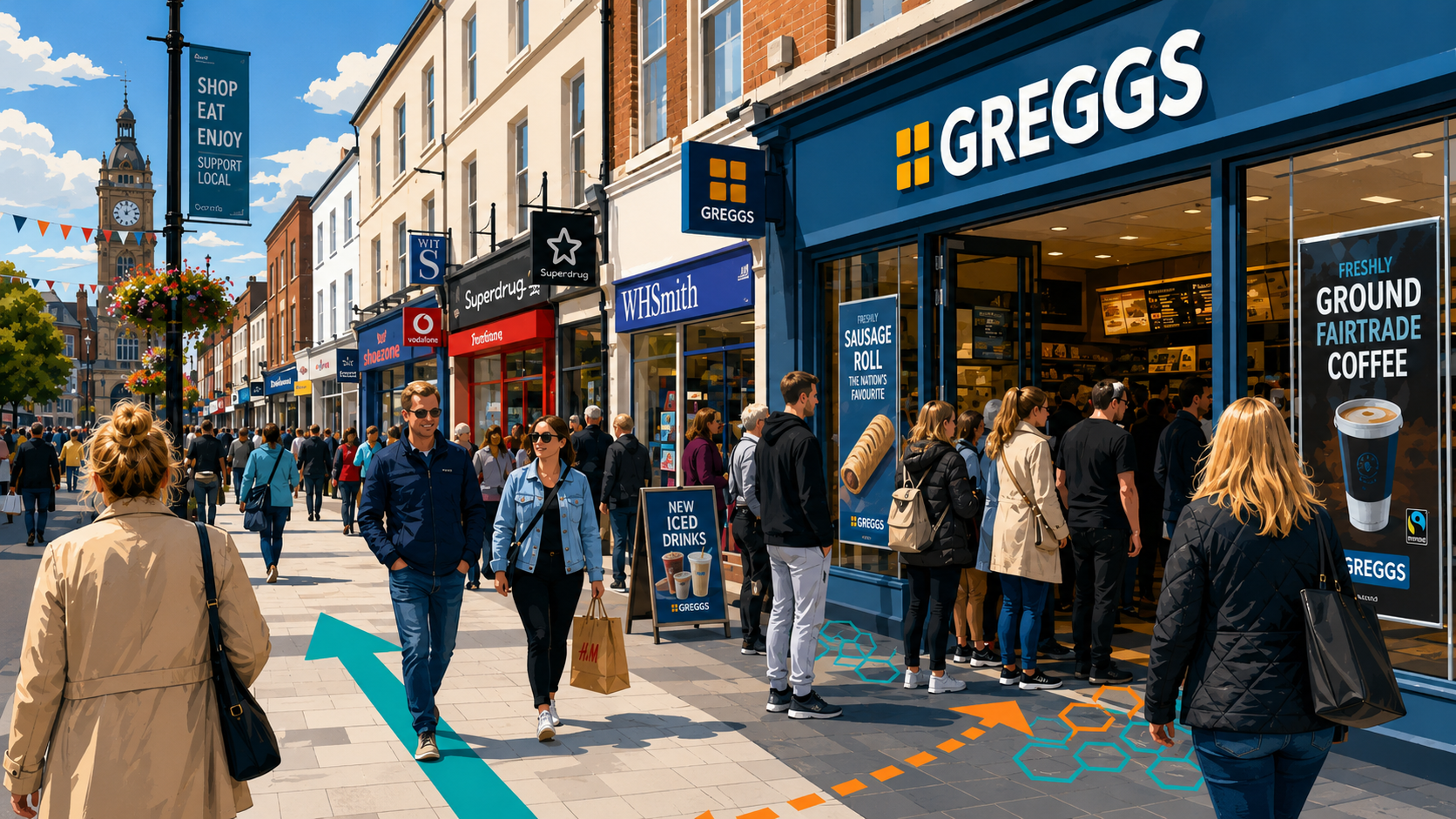
Bakery and food-to-go chain Greggs now has more than twice as many UK locations as Starbucks. With 2,773 shops trading as of June 2026, compared with Starbucks’ 1,304 UK stores at the end of its 2025 financial year, Greggs has built one of the largest food-to-go networks in the country.
And it isn’t finished yet. As Greggs believes there is potential for at least 3,500 UK shops over the longer term and expects to continue opening new locations at a significant pace.
That level of expansion depends on more than finding available retail units. It requires a detailed understanding of where demand exists, how people use different locations and whether a new site will add genuinely incremental business.
So, what can Greggs’ expansion tell us about making better location decisions?
Increasing access without simply adding more shops
Convenience has always been fundamental to Greggs’ business model. For food-to-go customers, being in the right place at the right time matters.
However, Greggs’ current strategy shows that increasing accessibility doesn’t necessarily mean placing more shops in already crowded locations. In the first half of 2026, 62% of its new shop openings, excluding relocations, were in areas where there was no other Greggs within a mile.
Where a new shop was opened within a mile of an existing one, Greggs reported that the transfer of sales from existing shops averaged less than 5%. The company factors this into its new shop appraisal process to assess whether greater accessibility will improve the overall performance of the catchment.
It is a useful distinction. The question isn’t simply whether an area can support another location. It is whether that location can create additional demand without undermining the performance of the existing estate.
Moving beyond the traditional high street
Greggs’ expansion is also increasingly taking it beyond the locations traditionally associated with the brand.
More than half of its new openings are now in locations such as petrol forecourts, supermarkets, retail parks, hospitals and university campuses. The business is also continuing to expand within major transport hubs, including railway stations and airports.
These locations reflect the changing ways in which people move, work, shop and travel.
For retailers and other location-dependent businesses, this makes understanding patterns of movement increasingly important. A busy town centre may appear attractive, but another location could provide better access to the right audience, at the right times and with less competition.
Raw footfall alone doesn’t tell the whole story. Understanding who is visiting an area, when they are there, where they have travelled from and what else is nearby can provide a much clearer picture of its potential.
Existing locations need reviewing too
Location strategy isn’t only about finding somewhere new. During 2025, Greggs relocated 50 existing shops, moving to better locations within the same area or expanding into neighbouring units.
This highlights an important part of estate planning that can easily be overlooked. A location that worked well several years ago may not necessarily be the best location today. Catchments evolve. New developments are built, competitors arrive, transport patterns change and customer behaviour shifts.
Regularly reviewing an existing estate can therefore be just as valuable as identifying opportunities for expansion.
The question becomes not only ‘where should we open next?’ but ‘are our existing locations still working as hard as they could?’
Matching the format to the location
Greggs is also experimenting with different ways of serving customers according to the opportunity a location presents.
Its smaller ‘bitesize Greggs’ format has been designed for high-footfall locations where there isn’t enough space for a conventional shop. The company is also trialling ‘Greggs Express’, a self-service food and coffee offer for convenience retail locations. This opens up another dimension to location planning.
Rather than asking whether a particular site fits an existing format, businesses can consider what format might best fit the opportunity. Customer demand, available space, surrounding businesses, movement patterns and the way people use an area can all influence what type of location is likely to work.
Better growth decisions start with understanding location
Greggs’ continuing expansion demonstrates how sophisticated location strategy has become. Businesses need to understand where there is untapped demand, how different catchments behave, what effect a new location could have on an existing estate and whether changing customer behaviour has created new opportunities. These are decisions where Location Intelligence can provide valuable evidence.
Periscope® brings together location, demographic, consumer, competitor and movement data to help organisations evaluate locations, compare opportunities and make more informed growth decisions. Whether you are planning expansion, reviewing an existing estate or trying to understand where the strongest opportunities lie, better evidence can give you greater confidence in where to focus next.
See how Periscope® can support your location decisions.