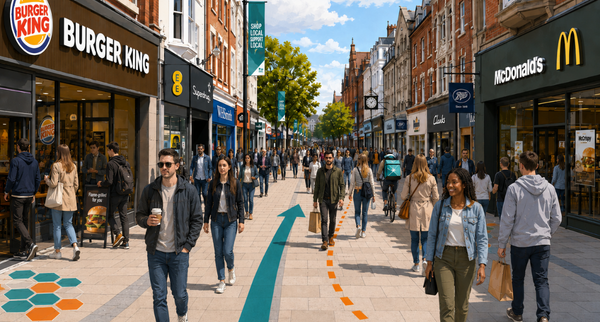
If there’s one brand that epitomises the benefits of location intelligence and geofencing, it’s Burger King.
“McDonald’s little brother”, as the chain is often referred to, has a long history of goading its bigger rival in order to cut into its market share. In December 2018, Burger King took its rivalry to the next level with the help of competitive insights made possible by applying location intelligence – specifically geofencing – to its mobile marketing strategy.
How did Burger King steal McDonald’s customers with geofencing?
Burger King leveraged its mobile app in order to send alerts to any customers who moved inside a 600-foot ‘geofence’ of a McDonald’s branch. The app offered them a deal to instead buy a Whopper for one cent from the nearest Burger King1. It also gave directions to help them get there2.
The promotion — dubbed “Whopper Detour” — ran for nine days, from 4 to 12 December 20183, so a little earlier than the Christmas period it’s sometimes remembered for4. It was supported by a #WhopperDetour social media hashtag as well as a cheeky video marketing campaign depicting confused McDonald’s employees receiving requests for Whoppers5.
How successful was the campaign?
The #WhopperDetour promotion was a huge success — and the final numbers were even more striking than the early estimates suggested. On day one, Burger King’s Global Chief Marketing Officer Fernando Machado estimated redemptions were running at around 20 times any previous app offer. By the time the promotion closed, more than 500,000 customers had redeemed the penny-Whopper offer — over 40 times Burger King’s previous record for a digital coupon, according to the campaign’s own Cannes Lions and One Club award submissions6.
The Burger King app also rose from ninth to first place in the iTunes App Store’s food and drink category as a result of the campaign7 — and briefly became the single most-downloaded app across the entire US App Store, adding more than 1.5 million downloads over the nine-day promotion, a 37.5% jump in the app’s all-time total8. Mobile order sales roughly tripled during the promotion itself9, and the campaign went on to sweep three Grand Prix — Titanium, Direct and Mobile — at the 2019 Cannes Lions International Festival of Creativity10.
What is geofencing?
The #WhopperDetour promotion was only possible using geofencing, a form of location intelligence that involves setting up digital ‘fences’ around locations important to your business. That could be your own premises, your competitors’ premises, transport hubs or specific amenities. You can then encourage customers to download your app and send them customised notifications and offers when they enter your geofenced areas.
Burger King spent about a year geofencing more than 14,000 US McDonald’s locations that were in close proximity to its own stores11. They chose a 600-foot radius to avoid targeting customers too close to McDonald’s to change their minds (e.g. customers who may already have entered the drive-through), but close enough to make it worth driving for a few extra minutes to make the saving.
What are the other benefits of geofencing?
Geofencing has several benefits outside of sending real-time promotions to customers. It also helps you build a pattern of customer movements, and understand their routines. Geofencing can also help you assess overall footfall around you/competitors’ locations and to assess whether this matches expectations.
The information you can gather from geofencing has value above and beyond individual promotions. It can help you gain a birds-eye view of how people physically move around the spaces in which you operate. This, in turn, can enable you to make strategic decisions about your presence and activity in individual locations.
Other brands using geofencing to win customers
Burger King’s stunt may be the best-known example, but geofencing has become a mainstream tool well beyond fast food — and beyond simply poaching a rival’s customers.
Taco Bell used location-data firm GroundTruth to identify customers near any of its roughly 7,000 US restaurants and serve them personalised mobile ads tied to its “Feed a Dream” charity promotion. The two-week campaign drove more than 170,000 store visits, with around 1 in 4 loyalty members who received an ad visiting a Taco Bell afterwards12.
McDonald’s turned the tables in 2018–19, geofencing more than 300 billboards across Southern California so that Waze users who stopped nearby were served a “Drive There” navigation button routing them to the nearest restaurant. The eight-week pilot generated 6.4 million mobile impressions and over 8,400 in-app navigations, and was successful enough that McDonald’s expanded it to Las Vegas, Arizona, Tampa, Orlando and Houston13.
Chick-fil-A showed how the technology has since moved from acquisition stunt to everyday operations. In a 2023 pilot at 100 US restaurants, geofencing in the Chick-fil-A app alerted kitchen staff the moment a customer with location services enabled approached the restaurant, cutting average wait times by one to two minutes14.
Closer to home, UK supermarket Morrisons ran a geo-targeted mobile campaign promoting fresh produce to shoppers within 5 kilometres of its stores. An independent post-campaign study found it lifted spontaneous brand awareness by 450% versus non-exposed shoppers — while measurably denting perceptions of rivals Tesco and Aldi15.
How can your business use geofencing going forward?
Of course, there’s a lot more to a successful location strategy than simply setting up a geofence. However, it can be a great place to start.
Analysing the data of an area can unlock valuable information for your business, from the reason why your commercial properties are performing the way they are to how your competition is gaining new customers. Whether you’re running a headline-grabbing stunt like Whopper Detour or a quieter operational upgrade like Chick-fil-A’s, geofencing works best when it’s grounded in a genuine understanding of where your customers — and your competitors’ customers — actually are.
The easiest way to do this is via location intelligence. It can provide detailed insight into local demographics and consumer behaviour to help you carve out new opportunities, improve existing sites and save you valuable hours, so you can spend more time on running your business.
Periscope® is a complete location intelligence platform that allows you to place multiple datasets alongside one another. Available 24/7 on any device and with a quick set-up, we can get you up and running within an hour.
Contact us for a free demo today.
Sources