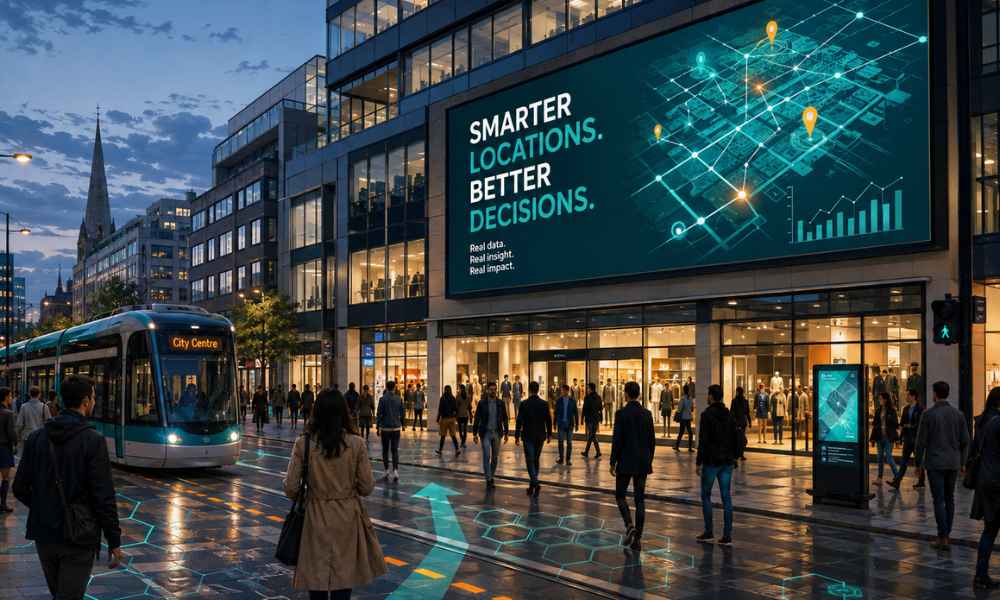
Location-based marketing has moved well beyond simply targeting people who happen to be near a particular store.
Location can influence where a campaign runs, which audiences it reaches, the message people see and how results are measured. Used well, it connects marketing activity with what is happening in the real world: where customers are, where they go and which locations matter to the business.
Here are four examples that show different ways brands have put location at the heart of their marketing.
Burger King: turning competitor locations into the campaign
Burger King’s Whopper Detour remains one of the best-known examples of geo-conquesting: using the location of a competitor as part of a marketing campaign.
Customers within 600 feet of a McDonald’s could use the Burger King app to order a Whopper for one cent before being directed to their nearest Burger King restaurant. The nine-day campaign generated more than 1.5 million app downloads and took the Burger King app to number one in both the Apple and Google Play app stores.
What made the campaign particularly clever was that location wasn’t simply being used behind the scenes to select an audience. The locations of Burger King’s biggest competitor became part of the idea itself.
The lesson: Location data becomes much more powerful when it supports a strong creative idea.
On Running: turning distance into the message
When sportswear brand On opened its first UK store on Regent Street in London, it used location in a very different way.
Digital out-of-home advertising appeared on JCDecaux screens on Oxford Street and around three major London transport hubs. On opening night, runners passing through Oxford Street were shown how far away the new store was, with that distance expressed as a proportion of a marathon.
The campaign combined location with other data including footfall, weather and Strava data. According to VIOOH, it delivered a 40% uplift in footfall on the store’s opening night. Here, location did more than determine where the advertising appeared. It made the message more relevant to both the audience and the brand.
The lesson: Sometimes location doesn’t need to be a hidden targeting tool. It can become part of the creative.
Decathlon: testing where greater investment makes a difference
Decathlon took a more analytical approach when it ran a three-week programmatic digital out-of-home campaign near stores in the Netherlands. The campaign appeared across 218 screens in Amsterdam, Rotterdam and The Hague, but Decathlon deliberately varied the amount of advertising in each city. That allowed the business to compare different levels of media investment with subsequent store visits.
Footfall at campaign stores increased by 46% during the period, although the control group also experienced a 38% increase because of seasonal factors. Broadsign therefore attributed an incremental eight percentage point lift to the campaign. There were also marked differences between cities. Amsterdam, which received the greatest share of advertising, saw a 59% increase in store visits, compared with 48% in Rotterdam and 26% in The Hague.
Rather than simply measuring whether the campaign worked overall, Decathlon was able to learn something about the relationship between location, media investment and store visits.
The lesson: Measure campaigns geographically and you can learn not only whether they worked, but where different levels of investment had the greatest effect.
Currys: connecting audience and location
Currys PC World used location data to reach relevant audiences around key stores, including homeowners, first-time buyers and people interested in premium appliances.
The advertising included maps and directions to nearby stores, while location technology was used to measure whether people exposed to the campaign subsequently visited. The campaign generated a reported 12.4% incremental uplift in store visits. What makes the example interesting is the combination of audience and geography. Knowing something about the type of customer you want to reach is useful. Knowing where those potential customers are in relation to the locations that matter to your business adds another layer.
The lesson: Customer insight and location insight become more useful when they’re considered together.
Location-based marketing and privacy
Using location data for marketing also brings responsibilities. Where activity involves personal data, businesses need to ensure it is collected and used lawfully, fairly and transparently. UK GDPR and data protection requirements apply, while PECR may also be relevant depending on the technology and marketing channel being used.
The technology may have become more sophisticated, but respecting people’s privacy and choices remains an important part of using it responsibly.
Start with the location decision, not the technology
These campaigns use location in very different ways. Burger King turned competitor locations into a creative idea. On used proximity as part of its message. Decathlon used geography to test media investment, while Currys combined audience and location to drive store visits.
But there’s a broader lesson here. Location-based marketing doesn’t have to begin with the question “How can we target someone based on where they are?”
It can start much earlier:
Where are our customers? Which areas contain more people like them? Where are our competitors? Which locations have the greatest potential? Where should we concentrate our marketing activity? And where is it actually producing results?
That’s where Location Intelligence can play a much wider role.
Periscope® brings customer, demographic, competitor, footfall and other location data together, helping businesses understand the markets and locations that matter before deciding where marketing activity should be focused. It turns location from a targeting tactic into part of the marketing decision.
See how Periscope® can help you understand where to focus your marketing and why.