Whether it’s sitting in the beer garden in the sun, a family Sunday lunch or meeting friends at your local, the pub is a British institution. It’s also one under pressure. The British Beer and Pub Association reports that 161 pubs closed across England, Scotland and Wales in the first three months of 2026, almost two a day. That makes the pubs that remain, and what they’re called, matter more than ever to their communities.bbc
Where it all began
The pub sign is thought to date back to Roman times. Tavern owners (tabernae) hung vine leaves outside to show they were open for trade. In Britain, vines were hard to come by, so landlords hung bushes instead. Historians believe this gave us some of the earliest pub names, such as The Bush, The Hollybush and The Bull & Bush.
In 1393, King Richard II passed an act making it compulsory for anyone brewing ale to sell to hang a sign outside, so the official ale taster could find them. Today there are thousands of pub names, from traditional ones like The White Swan in Coventry to more unusual ones like The Bucket of Blood in Cornwall or The Drunken Duck in Cumbria.
We know how much the local pub means to its community. That’s why we’ve added Food Standards Agency (FSA) data to our location intelligence platform, Periscope®. It gives us the names and locations of more than 53,000 pubs and bars across the UK. We took some of the most popular names to see whether location affects what pubs are called.
The Red Lion is still king
The Red Lion is the most common pub name in the UK. The FSA data shows more than 500 venues using it, and online guide Pubs Galore also puts it at number one, with 511 open pubs. It’s even growing. The Morning Advertiser reported a 10.4% rise in Red Lions over two years, from 468 pubs.
Nobody agrees on where the name came from. Some credit John of Gaunt, Duke of Lancaster and founder of the House of Lancaster, who died in 1399 and had a red lion on his coat of arms. Others point to James VI of Scotland, who became James I of England in 1603. He’s said to have ordered the Scottish red lion to be displayed on important public buildings, including pubs.
Periscope® shows you’re more likely to find a Red Lion in the Midlands than anywhere else in the UK: 15% are in the East Midlands and 13% in the West Midlands.
By contrast, the FSA data shows no Red Lions at all in Northern Ireland. Scotland has only 1% of the UK’s Red Lions, such as the one in Old Aberdeen, despite the name’s possible Scottish roots.
Anchor casts a wide net
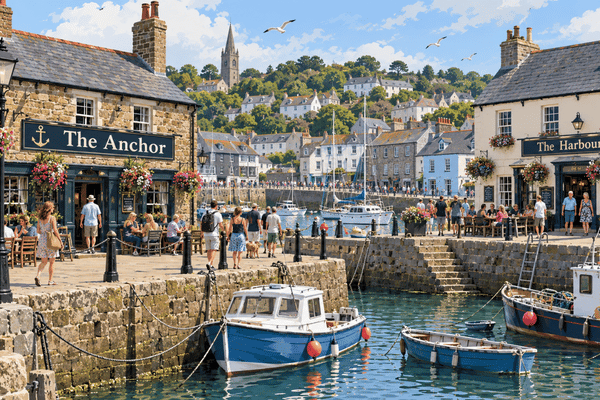
Anchor (133 pubs, according to Pubs Galore) has a more obvious origin: it usually points to local or family ties to the sea and waterways.
In Periscope®, 18% of pubs and bars with Anchor in their name are in the South East. That’s no surprise in a region home to Brighton, Dover and Portsmouth. More surprising is that 11% are far inland, in the West Midlands. The region has more than 520 miles of canal, so many of these Anchors may be a nod to its canal heritage.
Harbour pubs dock on the coast
Harbour is another name inspired by water, and here the link to location is strong. From Folkestone to St Ives and Margate to Bridlington, you’ll find plenty of Harbour Inns by the sea.
Not all of them are coastal, though. There’s the Cold Harbour in Swindon and The Harbour Inn on the banks of the River Severn in Bewdley.
Railway makes tracks across the UK
The Railway is in Pubs Galore’s top 10, joint sixth with 265 pubs. Our data shows it’s common right across the country. Every region has a Railway pub, inn or bar, from the Railway Tavern in Ballymena, Northern Ireland, to The Great Northern Railway Tavern in Hornsey, London.pubsgalore.co
The North West has the largest share (15%), followed by the South East (11%), then the East Midlands and South West (9% each). The higher numbers in these areas may reflect their industrial pasts and historic railway links.
Plough digs the countryside
Plough is also joint sixth on Pubs Galore, with 265 pubs, and it has a clear link to its surroundings. Pubs and bars with Plough in their name tend to be in rural areas.
The South East has the largest share (21%), followed by the East Midlands (15%) and the East of England (14%). Examples include a traditional Plough Inn in Spalding, the more unusual Pickled Ploughman in Banbury, and a twist on the classic with The Plough and Barleycorn on the Isle of Wight.
Why location matters
If you own a pub, plan to open one, or run any business that relies on footfall, knowing what’s around you can make a real difference.
We’re visual beings, and Location Intelligence software gives you a detailed map view that makes an area easy to understand. It can help you find the right customers to target and spot good new sites. For pub and bar owners, it can even help you choose a name that stands out, so you’re not confused with six other Red Lions nearby.