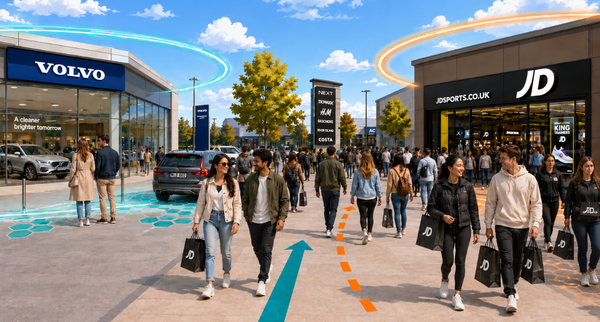
Geofencing is a key capability of location-based intelligence; one that offers you the chance to optimise profitability and enhance your data-gathering processes.
By setting up digital ‘fences’ around locations important to your business – your own stores, your competitors’, transport hubs and local amenities – you can track important customer information, automate promotional activities, and reach customers at the most relevant times. It’s a fast-growing capability, too: the global geofencing market was valued at $1.95 billion in 2022 and is forecast to reach $9.36 billion by 2030, a 21.7% annual growth rate, with retail already the largest single sector using it1.
In this article, we’ll introduce you to three of the most effective ways to integrate geofencing into your business strategy.
How to make an impact with geofencing
Here are three ways your business can leverage geofencing:
1) Location-based marketing
Geofencing is so much more than a passive data-gathering process. It’s an active, and intensely effective, marketing tool.
By setting up geofences of a pre-selected radius around all your locations, you can send out promotional materials to incentivise customers to visit your premises. This could be a discount, bespoke offer based on their purchasing history, loyalty-based offer, or simple showcasing of your new range.
The effectiveness of this approach is well documented: location-based mobile audiences achieve an average click-through rate of 7.53%, compared with just 0.90% for standard Facebook ads, and at a lower average cost-per-thousand-impressions too2 (It’s little surprise, then, that almost 90% of digital marketers now use location data in their campaigns, with location-targeted ad spend growing 40% year-on-year2.
For known customers, you can use geofencing to send out marketing emails, or push notifications direct to their mobile devices. Alternatively, you could use Facebook Advertising or Google AdWords to target as-yet unknown customers when they enter your geofence.
2) Geo-conquesting
Geo-conquesting – sometimes called ‘mobile conquesting’ or ‘competitive geofencing’ – is a form of geofencing, but with a twist.
Instead of simply setting up geofences around your own stores, you set them up around your competitors’. When a known customer, or someone who matches your target demographics, moves close to a competitor’s location, you can automatically dispatch a marketing message or position an ad to incentivise them to choose you instead.
Companies of any size can use this technique. In a widely cited campaign from around 2016, US retail giant Whole Foods worked with location-marketing vendor Thinknear to geofence competing grocery stores, reportedly achieving a 4.69% post-click conversion rate — more than three times the 1.43% national average for mobile ads at the time3.
The best-documented example of geo-conquesting in action, however, is Burger King’s 2018 “Whopper Detour” campaign against McDonald’s. Over nine days, Burger King geofenced roughly 14,000 McDonald’s locations across the US: any customer within 600 feet of a McDonald’s could unlock a Whopper for one cent, but had to order and collect it via the Burger King app — physically redirecting McDonald’s customers to their nearest Burger King4. The results were dramatic: 1.5 million app downloads in nine days, a jump from #686 to #1 on the Apple App Store, mobile sales that roughly tripled during the promotion, and a campaign the brand itself estimated returned 37:1 on its investment — on top of a Direct Grand Prix at the 2019 Cannes Lions festival4.
Smaller businesses stand to benefit too, without needing a household name or a national ad budget. One US Volvo dealership geofenced competing luxury dealerships over a 30-day test and saw a 140% lift in foot-traffic conversion rate compared with untargeted “natural” traffic, generating 132 showroom visits at roughly $21 cost per visit5. Geo-conquesting gives smaller businesses like this a means of feeding off the buzz surrounding larger entities, challenging their market dominance, and unlocking already saturated markets.
3) Footfall analysis
As well as allowing you to reach out to your customers, or your competitors’, geofencing helps you gather valuable data that will enhance your overall business strategy.
With geofencing, you can find out more about what makes your customers tick. You can gain a clearer picture of their regular patterns: where they work/visit, what routes they use to get there etc.
You can also use geofences to assess footfall in a given location. This could be close to a store, a competitor’s store, or major transport hub, for example. In the UK, this kind of data already shapes national retail reporting — the BRC-Sensormatic footfall index, for instance, recorded total UK footfall up 7.2% year-on-year in April 2025, with High Street, retail park and shopping centre footfall all tracked and reported separately each month6.
Using this information at a business level can make a measurable difference to expansion decisions. UK retailer JD Sports used location-intelligence data to refine its customer-catchment analysis, improving catchment-analysis precision by 25% and reducing location risk in its expansion decisions by 18%7 . Convenience retailer Circle K ran a controlled test of geofenced advertising across 124 stores, comparing it against standard regional targeting, and confirmed a measurable, positive uplift in store visits as a direct result of the geofencing8.
Using this information, you can make strategic decisions about how to allocate your resources, and what type of store would be most suitable for a particular location.
So, try out these innovative techniques and see how far geofencing could take your business.
Optimise the Location Intelligence of your business with Periscope®. Sign up for a demo.
Sources